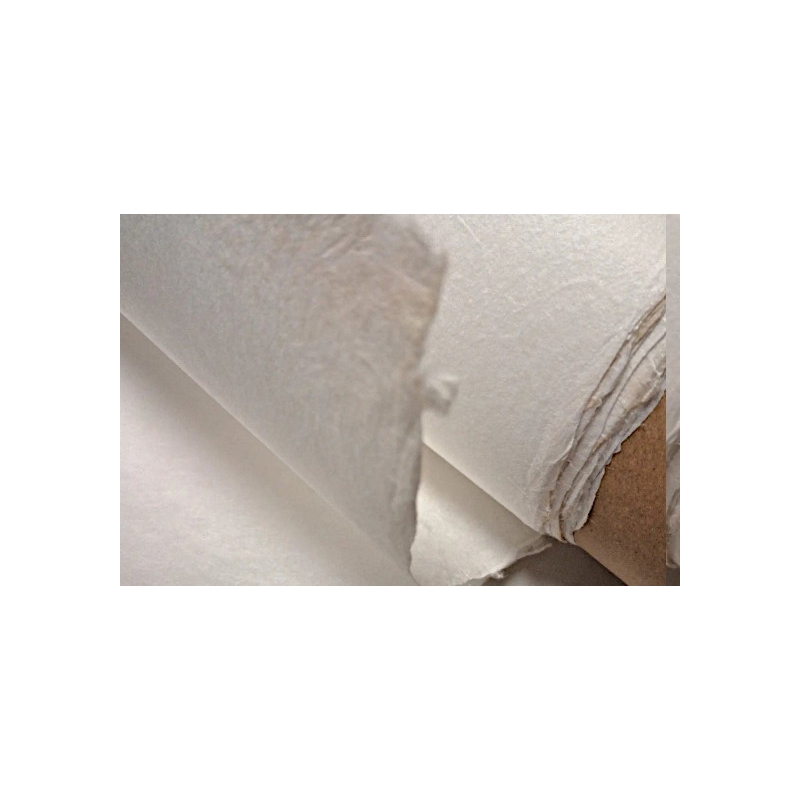
This historic and rare paper has been produced by the workshop since the 1920s, eventually replacing nearly all other supports previously used in classical Japanese painting. It has since held a near-monopoly among professionals and established artists. It features a pleasant almond-white hue and a smooth surface with a soft, dense texture.
Highly reliable, this paper is capable of supporting even the most demanding layers of paint.
To the touch, it has a thickness comparable to 160 gsm paper.
The paper’s uniform appearance is achieved through a very fine white coating known as *Gofun* (made from 100% crushed oyster shells).
It incorporates hemp fibers, which provide exceptional strength relative to its weight. The addition of ultra-fine *gampi* fibers creates a dense surface with a subtle sheen.
Its large format makes it perfect for large-scale works. As it is unsized, the paper can be dampened with water to create diffusion effects (*nijimi*).
This workshop is one of Japan’s most prestigious centers for the artisanal, handmade production of fine-art papers. It is also renowned for creating exceptionally large sheets—a process that requires between four and eight craftspeople to produce a single piece.
Today, the workshop is led by Makiko Iwano, the great-granddaughter of the founder and a fourth-generation member of this family of master papermakers. She has introduced modern refinements to a recipe that is over a century old.
Artists such as Hokusai and Hiroshige created their prints on papers from this tradition.
It is made using *kozo* (paper mulberry) from Nasu-Daigo—the highest-quality variety found in Japan.
 Maximize